Key Takeaways
- The single fastest way to filter agencies is to ask how they measure citation rate per platform. If they cannot separate ChatGPT, Perplexity, Claude, and Google AI Overviews, they do not understand the channel.
- Insist on month-to-month. AI search produces measurable movement inside 30 to 60 days, so no honest agency needs to lock you into a year.
- Real full-service retainers run $800 to $3,000 per month. Under $500 is usually a bot and a template. Over $5,000 with no multi-location or paid component is overhead you are subsidizing.
- Get asset ownership in writing before you sign. Your Foursquare, Bing, Apple Maps, Google Business Profile, and content should live under your accounts and your domain.
- Match the agency to your stage, not their size. Small business, mid-size, and scaling businesses each want a different kind of partner.
Why the Questions Matter More Than the Pitch
Most agency sales calls sound identical. Everyone says they do AI search. Everyone shows a slide with ChatGPT and Perplexity logos. Everyone promises to get you cited. The pitch tells you almost nothing, because the pitch is designed to sound the same regardless of whether the shop actually knows how AI engines pick businesses.
The questions are where the difference shows. A rebranded SEO agency will answer your questions about keywords, backlinks, and domain authority fluently, then go quiet when you ask how they track citation rate on Claude specifically. An agency that lives in this channel will answer that instantly and then teach you something you did not know.
This is not theory. A business can hold page-one Google rankings and still be completely invisible in ChatGPT, because those engines do not use Google's local data layer at all. We wrote about exactly that in why your page-1 Google rankings do not get you cited by AI search. If an agency cannot explain that gap, they will spend your money on the wrong scoreboard.
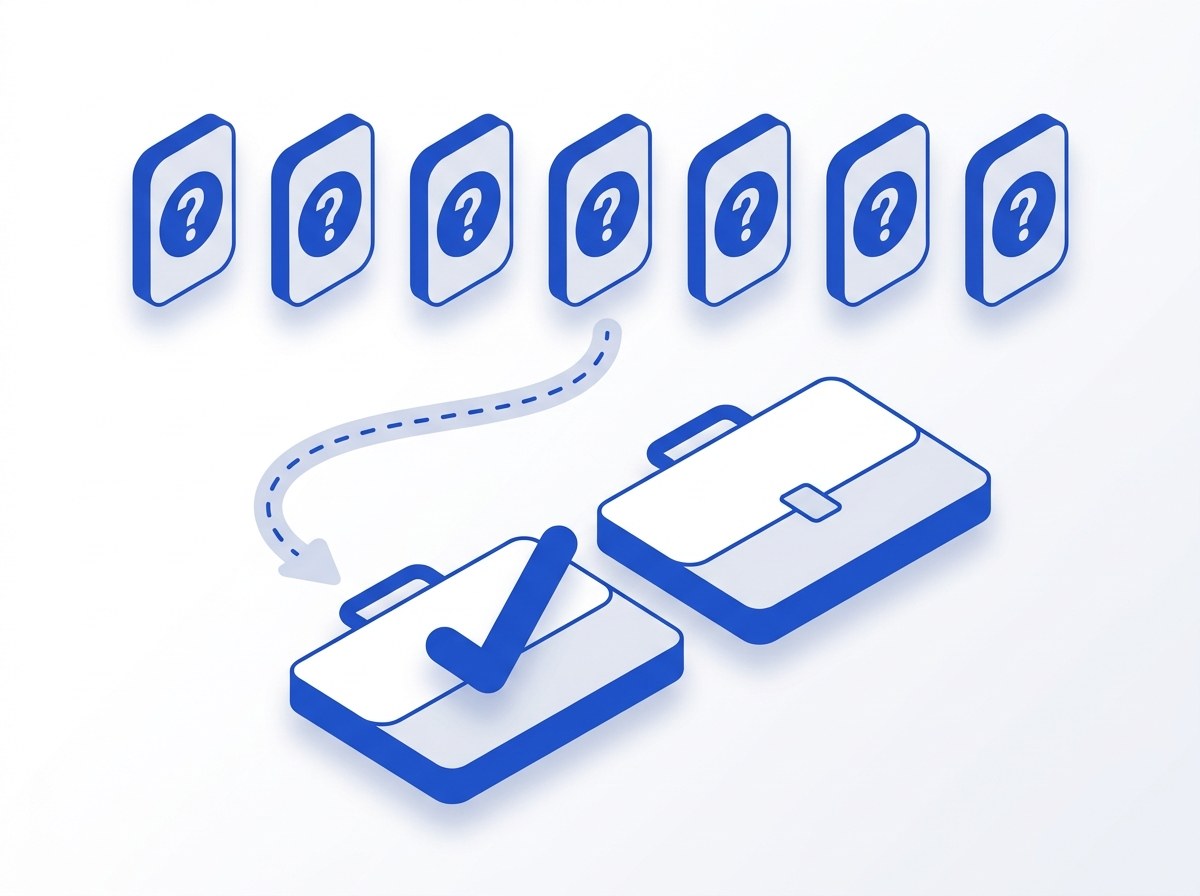
The 7 Questions to Ask First
Ask these in order, on the first call, before you talk price. Write down the answers. The pattern of how they respond tells you more than any single answer.
- How do you measure citation rate per platform? You want separate numbers for ChatGPT, Perplexity, Claude, and Google AI Overviews. One blended AI visibility score is a way to hide weak platforms behind strong ones.
- Can you show two references currently cited across multiple AI engines? Not testimonials. Live citations you can verify by running the query yourself.
- Is this month-to-month? Movement happens fast enough that no one needs to lock you in. Push on this hard.
- Do you handle Foursquare, Bing Places, Apple Maps, and schema in-house? These feed the engines directly. If it is all outsourced, quality and speed slip.
- What does success look like at 30, 60, and 90 days? You want numbers and milestones, not adjectives.
- Do you produce comparison and decision-stage content? Ask for three live examples. Perplexity and Claude reward this content heavily.
- Who owns the assets if we part ways? Profiles under your email, content on your domain, in writing.
If you want a deeper primer before the call, the AI search optimization FAQ covers the mechanics that these seven questions are quietly testing for.
Red Flags That Should End the Call
Some answers are disqualifying on their own. When you hear these, thank them and move on.
- Guaranteed rankings or guaranteed citations. Nobody controls how a model cites. Guarantees mean they are either lying or planning to game a metric that does not translate to inquiries.
- A 12-month contract required before any baseline. This protects their revenue, not your results.
- One blended AI score with no per-platform breakdown. It exists to hide the platforms where you are invisible.
- Content hosted on a subdomain they control. That is renting visibility you will lose the day you leave.
- They cannot explain the Google-versus-ChatGPT data gap. This is the single clearest tell of rebranded SEO.
- Pricing under $500 per month for full service. That is a template and a bot, not a strategy.
If your current agency is tripping these flags, the honest next step is to test whether the problem is them or the approach. Our guide on why a competitor shows up in ChatGPT and you do not is a good way to pressure-test whether the work is actually being done.
Green Flags Worth Paying For
The good signals are just as specific. When you hear these, you are talking to someone who does the work.
- They baseline before they promise. Week one is documenting where you appear and where you do not, per platform and per query.
- They report per platform. Separate citation rates for ChatGPT, Perplexity, Claude, and Google AI Overviews, every month.
- They teach you the mechanism. Foursquare feeds ChatGPT. Authoritative citations and schema feed Claude. Comparison content feeds Perplexity. If they explain it clearly, they understand it.
- They hand you ownership. Profiles under your logins, content on your domain, no hostage-taking.
- They tie work to inquiries, not vanity metrics. The goal is calls and booked clients, not a citation count that never converts.
A dental practice in Phoenix we worked with went from zero citations to appearing across three engines inside 60 days precisely because the work started with a baseline and a per-platform plan, not a promise. If you want to see how that first stretch is supposed to feel, read what to expect in the first 30 days.
The Three-Bucket Decision Framework
Match the agency to your stage. The most common expensive mistake is buying the wrong size of partner for where your business actually is.
Choose a small specialist if you are a single-location business under roughly $500,000 in revenue.
You want a lean shop running month-to-month at $800 to $1,500. Your foundation work, Foursquare, Bing, Apple Maps, schema, and a modest content cadence, moves the needle fast and does not require an enterprise team. Buying big-agency overhead here means paying for account managers you do not need. A restoration company in Wisconsin at this stage got most of its early citation wins from foundation work a single focused specialist handled in the first month.
Choose a mid-size agency if you have multiple locations or a competitive vertical.
Here you need content volume and citation-network depth that a solo operator cannot sustain. Budget $1,500 to $3,000 per month and demand per-platform reporting across all your locations. Comparison content for Perplexity and authoritative citations for Claude both take real production capacity. This is the band where our 2026 pricing benchmark for dentists lands for most competitive local markets.
Choose neither, and go hybrid, if you are scaling fast or running paid media.
If you are moving quickly, the right answer is often to do the foundation in-house and hire for depth. DIY the profiles and schema, which is roughly 4 to 6 hours and $0 in software, then bring in an agency for ongoing comparison-content production and citation-network maintenance. The DIY versus hire decision guide walks through exactly where that line sits, and the honest answer is that most scaling businesses run a hybrid rather than picking one extreme.
What Real AI Search Retainers Cost
Price is not the first question you ask, but you should know the honest ranges before anyone quotes you. For a single-location local business, a real full-service retainer runs $800 to $3,000 per month. The low end covers foundation plus monthly maintenance. The $1,500 to $2,500 middle band adds consistent comparison and decision-stage content plus per-platform tracking. The top of the range is for multi-location and competitive verticals where both content and citation networks scale up.
DIY foundation work costs $0 in software and 4 to 6 hours of your time, which is why the smartest scaling businesses do that piece themselves and pay only for the ongoing depth. If someone quotes under $500 for full service, you are buying a template. If someone demands $5,000-plus with no multi-location or paid-media component to justify it, you are subsidizing overhead. For a full channel-versus-channel view of where this money is best spent, compare it against ChatGPT optimization versus Google Ads.
The point of all seven questions, the red flags, and the buckets is the same: you are hiring for a mechanism most agencies do not actually understand yet. Ask the questions. Verify the references. Own your assets. Then pick the size that matches your stage, and hold the agency to per-platform numbers at 30, 60, and 90 days.
Want a straight answer on where you actually stand across ChatGPT, Perplexity, Claude, and Google AI Overviews before you hire anyone? We will run the baseline and tell you the truth, including if you do not need us.
Frequently Asked Questions
Who owns the content and profiles if I fire the agency?
You should, in writing, before you sign anything, and most owners never ask. When I audited 60+ local businesses, more than 90% were invisible in AI answers, and a chunk of them had already paid an agency that built the Foursquare claim, the Apple Maps profile, and the blog content inside its own accounts. Leaving meant losing all of it. Ask directly: are my profiles claimed under my email, and does my content live on my domain? If they host content on a subdomain they control or manage profiles under agency logins, you are renting your own visibility. Get ownership in writing on day one: the Google Business Profile, the Bing and Apple Maps listings, the Foursquare claim, and every page of comparison content should belong to your business, not the vendor's login. A confident agency hands you the keys instead of holding them, and one that resists is telling you exactly what leaving will cost.
Should I sign an annual contract or go month-to-month?
Go month-to-month, and treat a demand for 12 months up front as a red flag. A restoration company we set up on foundation work alone reached #1 in ChatGPT for its home city about four weeks in, so the movement shows up fast enough that no honest agency needs to trap you. Profile fixes, schema, and baseline citation tracking are all measurable inside 30 to 60 days. Annual contracts protect the agency's revenue, not your results. The one fair exception is a small discount for a 6-month commitment after you have already watched 60 to 90 days of real per-platform movement. If someone wants a year before showing you a single citation number, keep looking.
What questions should I ask before hiring an AI search optimization agency?
Start with these seven. (1) How do you measure citation rate per platform for ChatGPT, Perplexity, Claude, and Google AI Overviews? (2) Can you show 2 references currently cited across multiple AI engines? (3) Is the engagement month-to-month or locked into a contract? (4) Do you handle Foursquare, Bing Places, Apple Maps, and schema in-house or outsource it? (5) What does success look like at 30, 60, and 90 days, in numbers? (6) Do you produce comparison and decision-stage content, and can you show three live examples? (7) Who owns the assets you build if we part ways? An agency that dodges any of these is usually selling traditional SEO with a fresh coat of paint. Verify every reference by running the query yourself.
How much should AI search optimization actually cost per month?
For a single-location local business, a real full-service retainer runs $800 to $3,000 per month. The low end covers foundation and monthly maintenance: Foursquare, Bing Places, Apple Maps, schema, and a modest content cadence. The $1,500 to $2,500 middle band adds consistent comparison and decision-stage content plus per-platform citation tracking. The top of the range, $2,500 to $3,000-plus, is for multi-location or competitive verticals where citation networks and content volume both scale up. Be skeptical of anything under $500 per month, which usually means a bot and a template, and anything demanding $5,000-plus with no multi-location or paid-media component to justify it.
How do I know if an agency actually understands AI search versus rebranded SEO?
Ask them to explain, out loud, why a business can rank on page one of Google and still be invisible in ChatGPT. If they cannot separate Google's local data layer from the data sources ChatGPT, Perplexity, and Claude pull from, they do not understand the channel. A real answer covers Foursquare feeding ChatGPT, authoritative citations and schema feeding Claude, and web-context comparison content feeding Perplexity. Rebranded SEO shops talk about keywords, backlinks, and domain authority as if AI engines rank the same way search does. They do not. The mechanism is different, and the agency should be able to teach it to you in plain language in under five minutes.
What is a fair way to measure results in the first 90 days?
Baseline first, then track movement. In week one, a good agency documents where you appear and where you do not across ChatGPT, Perplexity, Claude, and Google AI Overviews for your core queries. By day 30, expect foundation fixes live and early citation appearances on the easiest queries. By day 60, citation rate should be climbing and comparison content should be indexed. By day 90, you want a measurable citation rate of 20 to 40 percent across platforms plus attributable inbound inquiries. If the only report you get is traffic or rankings with no per-platform citation number, you are being measured on the wrong scoreboard.
Is it cheaper to optimize for just one AI platform like ChatGPT?
Not really, and it is usually a mistake. The foundational work overlaps across every platform: clean Foursquare, Bing Places, Apple Maps, NAP consistency, and schema help ChatGPT, Claude, and Google AI Overviews at the same time. Paying $800 to $1,500 for single-platform work rarely saves money because you still need the same base. What differs is depth: comparison content for Perplexity, authoritative citations for Claude, Foursquare category depth for ChatGPT. Any agency selling itself as a ChatGPT-only specialist for a premium is charging you extra for a slice of work that a full-service retainer at the same $1,500 to $3,000 already includes.
How do I choose between a small local shop and a larger agency?
Match the agency to your stage, not their size. If you are a single-location business under roughly $500,000 in revenue, a small specialist or a lean agency running month-to-month at $800 to $1,500 is usually the right fit. If you are mid-size with multiple locations or a competitive vertical, look for an agency that can scale content and citation networks at $1,500 to $3,000 and reports per platform. If you are scaling fast or running paid media alongside organic, you want a partner who ties AI search to attribution and revenue, not a citation count that never converts. The wrong move is buying enterprise overhead for a single-location practice, or handing a five-location rollout to a solo freelancer.
We also cover this in more detail in our guide to Is AI Search Optimization Different From SEO, and Do I Need a Separate Tool for It: How to Decide (2026 Guide).
There is a fuller walkthrough in Burned by Three Marketing Agencies? How to Set Up the Fourth So You Can Fire It With Evidence.
Worth reading next: Is Your SEO Agency Doing Anything? Three Questions They Should Answer in Ten Minutes.

About the author
Matthew Johnson is the founder of Pleiades Consultancy. He previously scaled his own marketing agency to multiple six figures before serving as CMO of an Amazon agency, where the client base tripled from 15 to 45 active clients during his tenure. He worked with some of the largest names in e-commerce, including Ridge Wallet, HexClad, BK Beauty, The Woobles, Walkize, Lonely Planet, and Obvi. He now works with local businesses to maximize their client acquisition and visibility through AI search with ChatGPT, Claude, Gemini, Perplexity, and Bing Copilot.