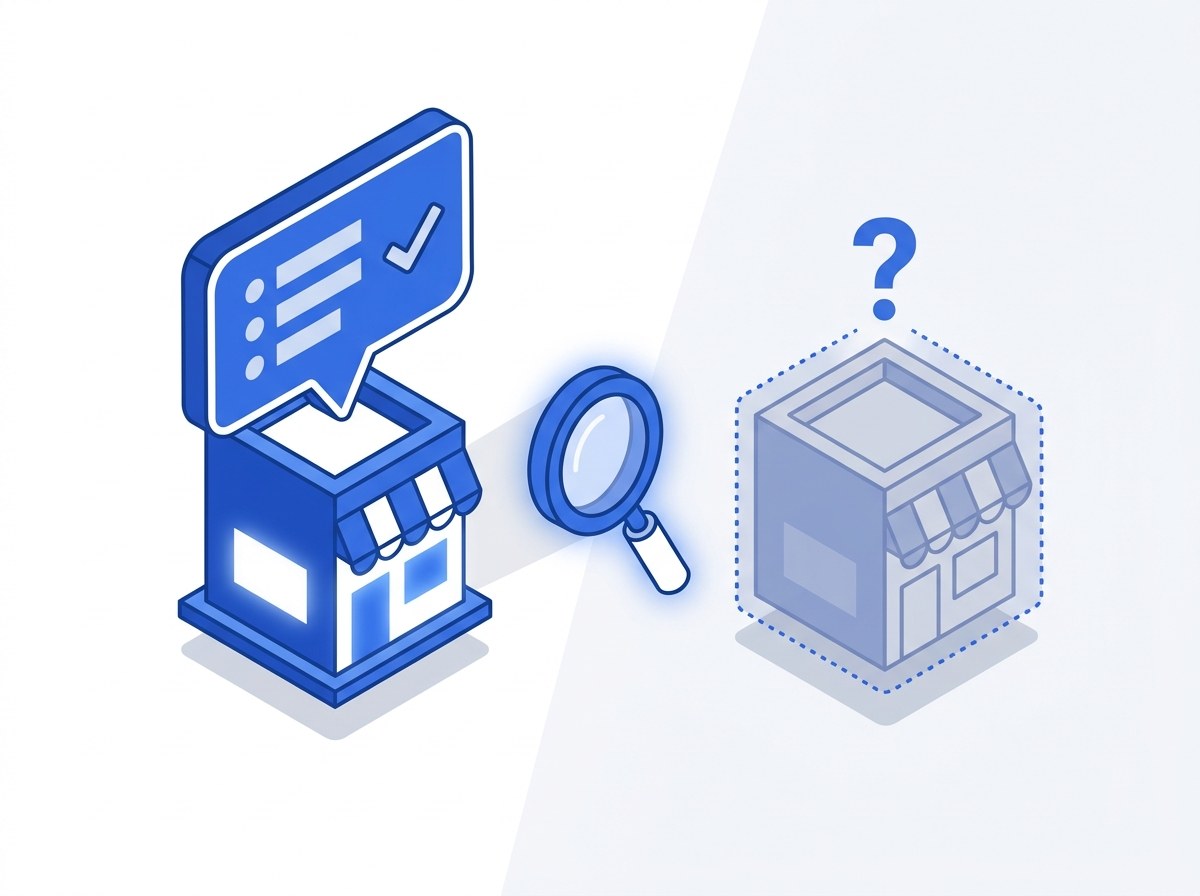
The Short Answer
- It is not reviews. Almost never. Stop blaming review count.
- Signal 1: They have a page for the literal service. You have "Our Services".
- Signal 2: Their schema is a specific industry subtype. Yours is generic or missing.
- Signal 3: They are claimed on Foursquare and Apple Maps. You are not.
- Signal 4: Their site is indexed in Bing. Yours has 12 pages indexed at best.
- Signal 5: They have 40+ third-party mentions. You have 5.
- Close the gap in: 30-60 days if you fix all five.
The Short Answer: It Is Almost Never Reviews
Every owner who runs this query for the first time arrives at the same conclusion. "They have more reviews than me. That must be it." It almost never is. We have audited 200+ local businesses now, and the businesses getting cited in ChatGPT routinely have fewer reviews than the ones being ignored. Reviews are a Google Maps signal. ChatGPT does not run on Google Maps. It runs on a stitched-together knowledge graph built from structured data, indexed text, and brand mentions across the open web.
Your competitor is winning because they are legible to a language model. You are not. The good news is that legibility is engineered, not earned. The five signals below are what we check in every competitor audit, in the order we check them. Run the same audit on the competitor that came up in your ChatGPT query and you will see the pattern.
The 5-Point Competitor Audit
Open a fresh browser tab. Open your competitor's website in one tab and a notes doc in another. You will run five checks and write down what you find. The whole audit takes 25-40 minutes per competitor. Do it for the top 3 competitors that ChatGPT named and patterns will jump out within the first one.
The five signals, in priority order: (1) topic-specific content, (2) schema markup, (3) citation network including Foursquare and Apple Maps, (4) Bing index coverage, (5) brand mentions across the open web. Signal 1 is the highest leverage. Signal 5 is the slowest to fix. Start with 1 and work down.
Signal 1: Do They Have a Page for the Exact Service?
Go to their site. Find their navigation. Count how many service-specific pages they have. Most winning competitors have a separate page for every single service they offer, often with a sub-page per service-plus-location combination. You probably have a single "Services" page with a bulleted list. That is the most common reason ChatGPT picks them.
The query is literal. If a user asks ChatGPT "who does emergency water damage restoration in Phoenix at 2am", the engine looks for a page that owns that intent. Your competitor probably has "Emergency Water Damage Restoration in Phoenix - 24/7 Response" as an H1 on a dedicated URL. You have a paragraph buried on a homepage. The H1 match alone is worth more than 100 reviews. This is the foundation of the decision-stage content strategy that wins AI citations.
Action: list every page your competitor has that owns a specific query. Compare it to your site. Every page they have that you do not is a query you are losing by default.
Signal 2: What's in Their Schema Markup?
Right-click on their service page. Click View Page Source. Ctrl+F for "application/ld+json". You will either find one or more JSON blocks or you will find nothing. If you find nothing, they are not winning on schema and signals 3 through 5 are the gap. If you find blocks, copy them into Google's Rich Results Test and read the output.
Look at the @type field. Generic LocalBusiness is the floor. Specific subtypes (Dentist, HVACBusiness, LegalService, MedicalClinic, AutoRepair, PestControlService) are what AI engines weight heavily because they encode "what this business actually does" into a single field the model recognizes. The full implementation guide lives in our schema markup pillar. Most local sites have either no schema or generic LocalBusiness. If your competitor has a subtype-specific schema with FAQPage and Service blocks on the same page, that is the gap.
Action: screenshot their schema blocks. Write down the @type values, any FAQPage entries, any Service entries, any sameAs links to social profiles. Then run the same audit on your own site. The delta is your roadmap.
Signal 3: Are They Cited on Foursquare and Apple Maps?
This is the most underrated signal in local AI search and the one most owners have never even thought to check. Go to foursquare.com, search for your competitor's business name and city. Then open Apple Maps (you need an iPhone or Mac) and search the same. If they show up with a complete profile (full hours, categories, photos, website, phone), they are feeding the two data layers that ChatGPT and Apple Intelligence pull from heavily.
Foursquare licenses its local business data to OpenAI, Anthropic, and other model providers. It is the structured backbone of a huge percentage of AI local recommendations. Apple Maps feeds Siri and the new Apple Intelligence layer that is now in iMessage, Safari, and the iPhone discovery flow. The detailed why-it-matters is in our Foursquare AI search signal post. Most local owners have never claimed either listing. If your competitor has and you have not, that is a 30-day fix that closes a meaningful part of the gap.
Action: confirm whether they are claimed on both. Note the categories they used, the photos they uploaded, the service entries they populated. Then claim yours and match or exceed them.
Signal 4: Bing Index Coverage (the Sneaky Important One)
ChatGPT search uses Bing as its primary live web index. Not Google. Bing. If your pages are not in Bing's index, ChatGPT search cannot retrieve them in real time. Most local sites have been submitted to Google Search Console at some point. Almost none have been submitted to Bing Webmaster Tools.
Run this query in Bing.com: site:competitorsite.com. Count the indexed pages Bing reports. Then run site:yoursite.com. The gap is usually a 5-10x difference, and that is the entire reason ChatGPT is retrieving their pages and not yours. The fix is Bing Webmaster Tools, sitemap submission, and IndexNow integration. We cover the full setup in the Bing Webmaster guide. It takes 30-45 minutes and a single deploy.
Action: get the indexed page count for both sites. If the gap is more than 3x, this signal alone explains a meaningful portion of the ChatGPT visibility difference.
Signal 5: Brand Mentions Across the Open Web
Google "competitor name" in quotes, exclude their own site, and count the unique third-party domains that mention them. Use site exclusion: "Competitor Name" -site:competitorsite.com. Count the unique domains in the first 5 pages of results. Anything above 40 unique mentions is strong. Below 10 is weak.
What counts as a brand mention: local news features, podcast appearances, BBB or Chamber of Commerce listings, niche directory entries (Healthgrades, Avvo, Angi, HomeAdvisor, vertical-specific), "best of" roundup lists, supplier or partner pages, association memberships, sponsorship pages. Language models compress this into a confidence score that your business exists and is real. The full list of mention sources is in the citation network strategy playbook.
Action: write down their unique mention count and yours. This signal is the slowest to fix because it requires outreach, PR, and time. Start it now even though you will not see results for 60-90 days.
Side-by-Side: Competitor vs You
Fill this in after running the audit. The empty column is your work list.
Patterns from 200+ local business audits across dental, restoration, HVAC, legal, and home services.
How to Close the Gap
Order matters. Do the work in this sequence and you will see citations move within 30-60 days. Skip the sequence and you will spend money on the wrong work.
Week 1: claim Foursquare and Apple Maps. Submit your site to Bing Webmaster Tools and push a sitemap. These three actions take 90 minutes total and move the needle within 14 days. Week 2: ship a dedicated page for the exact service that lost to your competitor. Decision-stage content, literal H1, FAQ section. Week 3: add LocalBusiness schema with your industry subtype, plus FAQPage and Service schema on the new page. Week 4: start brand mention outreach (Chamber, BBB, niche directories, local podcast pitches).
If you want the full playbook with the diagnostic, the work plan, and the day-30 benchmarks, the entire engagement is documented in our first 30 days post. If you want to know what each tier of work actually costs to do this yourself versus hire it out, the breakdown is in the cost guide. If you are wondering whether to DIY or hire, the matrix is in the DIY vs agency pillar.
Want us to run the audit on your top competitor?
Free 15-minute call. Send us the competitor that came up in ChatGPT. We run all five signals live on the call and tell you exactly what they have that you don't. No commitment.
Book the Free Competitor AuditFrequently Asked Questions
Why does my competitor show up in ChatGPT but I don't?
Almost never because they have more reviews. It is structural. They likely have a page that exactly matches the query (decision-stage content for the literal service), LocalBusiness schema with the correct industry subtype, presence on Foursquare and Apple Maps (which ChatGPT pulls heavily from), a Bing index entry for the page (ChatGPT search uses Bing as its primary substrate), and brand mentions across third-party sites that the language model has already memorized. Fix those four and you close the gap in 30-60 days.
How do I check what schema markup my competitor is using?
Three steps. (1) Go to their service page in your browser. (2) Right-click, View Page Source, and Ctrl+F for 'application/ld+json'. You will see one or more JSON blocks. (3) Copy each block, paste it into Google's Rich Results Test or Schema.org Validator. Pay attention to the @type field. Generic LocalBusiness is weak. Specific subtypes like Dentist, HVACBusiness, LegalService, MedicalClinic, or HomeAndConstructionBusiness are strong. Also check for FAQPage, Service, and BreadcrumbList schema on the same page. The combination is what gets cited.
Does my competitor really need to be on Foursquare for ChatGPT to find them?
Yes, and most local owners do not realize this. Foursquare's data licensing feeds a huge portion of OpenAI's local business knowledge graph. If your competitor is claimed and complete on Foursquare and you are not, ChatGPT has a structured record of them and a blank for you. Apple Maps Connect is the second layer, especially as Apple Intelligence rolls into iPhone search, Siri, and Safari. These two together are worth more than 30 more Google reviews.
How do I check if my competitor is indexed in Bing?
Go to Bing.com and search 'site:competitorsite.com'. Count the indexed pages. Then run the same query for your site. If they have 80 indexed pages and you have 12, that is the answer. ChatGPT search uses Bing as its primary live index. If your pages are not in Bing, ChatGPT cannot pull them in real time. The fix is Bing Webmaster Tools, sitemap submission, and IndexNow integration. Most local sites have never been submitted to Bing Webmaster at all.
What counts as a brand mention across the open web?
Any third-party page that names your business in a non-paid context. Local news mentions, podcast guest spots, niche directory listings (BBB, Healthgrades, Avvo, Angi, HomeAdvisor, Yelp, vertical-specific directories), 'best of' roundup lists, association memberships, Chamber of Commerce listings, and supplier or partner pages that link to you. Language models compress these into a probability that your business exists and is real. Competitors with 40-60 unique mentions across the web get cited far more often than competitors with 5.
Do I need to copy my competitor's exact page structure to catch up?
No, but you need to own the same query. If they have a page titled '[Service] in [City]: Cost, Process, and What to Expect' and you have a page titled 'Our Services', they win every ChatGPT query about that service in that city. You do not need to clone their page. You need a page that owns the literal question, has the right schema, and links internally to your other pages. Better answer, same query intent, distinct voice.
How long does it take to close the gap once I fix all five signals?
30-60 days for first citations, 60-90 days for parity, 90-180 days for dominance if you keep publishing. The Foursquare and Apple Maps signals propagate in 7-21 days. Schema gets indexed in 1-7 days. The content piece needs 7-14 days to appear in AI engine responses after publication. Bing indexing takes 1-3 days if you submit via Webmaster Tools. Brand mention work is the slowest signal because it requires outreach and time. Full timeline expectations are in the timelines pillar.
What if my competitor has 200 more reviews than me?
Reviews matter for traditional local SEO and Google Maps ranking. They matter much less for ChatGPT and Perplexity citations. AI engines weight structured data and content match over star count. We have audited businesses with 12 reviews getting cited over competitors with 400, because the 12-review business had the right schema, the right page, and presence on Foursquare. Stop using review count as the explanation. It almost never is.
Stop guessing why they win. Run the audit.
Free 15-minute call. We run live ChatGPT queries and the full five-signal audit on the competitor that beat you. You leave with a specific gap list and a 30-day plan.
Book the Free Audit
About the author
Matthew Johnson is the founder of Pleiades Consultancy. He previously scaled his own marketing agency to multiple six figures before serving as CMO of an Amazon agency, where the client base tripled from 15 to 45 active clients during his tenure. He worked with some of the largest names in e-commerce, including Ridge Wallet, HexClad, BK Beauty, The Woobles, Walkize, Lonely Planet, and Obvi. He now works with local businesses to maximize their client acquisition and visibility through AI search with ChatGPT, Claude, Gemini, Perplexity, and Bing Copilot.