Key Takeaways
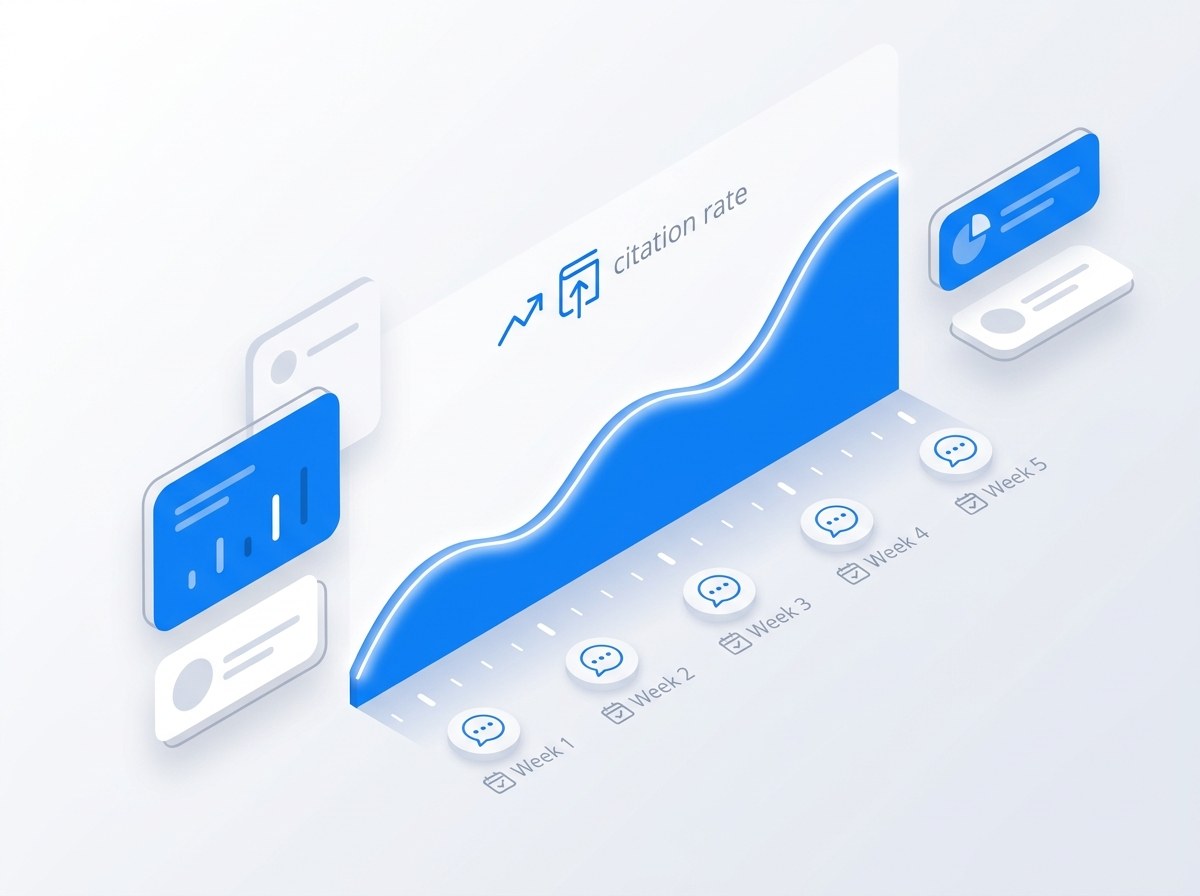
- Citation rate is the primary AI search KPI. The percentage of relevant queries where your business is mentioned in the AI response across ChatGPT, Perplexity, Claude, and Google AI Overviews.
- DIY tracking costs $0 in software and roughly 90 minutes of setup plus 30 minutes per week. Run 8 to 12 representative queries across all four platforms and log results in a spreadsheet.
- Paid tooling starts at Localrank.so for $79 per month. Mid-tier (Otterly.ai, Profound) runs $149 to $499. Enterprise tools like Athena and BrandRank.ai run $500 to $2,000 per month with competitor benchmarking.
- Benchmarks from auditing 200+ local businesses: pre-optimization most sit at 0 to 8% citation rate. Day 30: 8 to 20%. Day 60: 20 to 35%. Day 90: 30 to 55%. Realistic ceiling is 60 to 75%.
- Track weekly during the first 90 days of active optimization and monthly during steady state. Quarterly is too infrequent because AI data sources update faster than that.
TL;DR
- Primary metric: Citation rate = % of relevant queries where your business is mentioned by AI
- DIY method: $0, 90-min setup, 30 min/week ongoing
- Cheapest tool: Localrank.so at $79/month
- Mid-tier tools: Otterly.ai, Profound at $149 to $499/month
- Enterprise tools: Athena, BrandRank.ai at $500 to $2,000/month
- Tracking cadence: Weekly during active optimization, monthly steady-state
- Good citation rate: 30 to 55% by day 90 of optimization
Citation rate is to AI search what keyword rankings were to traditional SEO. If you haven't yet decided whether AI search optimization is worth the spend at all, start with the side-by-side breakdown vs traditional SEO. If you're not sure where AI is even pulling its data from, the Foursquare connection post covers the source most local businesses are missing. And the ChatGPT vs Perplexity vs Claude comparison walks through which platform actually drives the most local inquiries (it's not the one most agencies talk about).
What to Measure (and What's Not Worth Measuring)
The primary metric is citation rate. Everything else is secondary or distracting.
Citation rate (PRIMARY)
% of your defined query set where your business is mentioned by AI in the response. Calculated per platform. The single number that tells you whether AI search is working.
Position in citation (SECONDARY)
When cited, are you mentioned 1st, 2nd, or 3rd? Important because position 1 gets clicked and called more often than position 3. Most useful for established businesses tracking incremental lift.
Competitor share (SECONDARY)
When your business is NOT cited, who is? Useful for understanding whether you're losing to a specific top competitor or to a long tail of small competitors.
Inbound inquiries (RESULT METRIC)
Track how many leads mention "ChatGPT recommended you" or "I asked AI". Add a single dropdown to your intake form. Citation rate is the leading indicator. Inbound inquiries are the result.
NOT worth tracking (yet)
AI traffic referrals to your website (most AI platforms still don't pass referrer reliably). Sentiment analysis of AI mentions (overkill for most local businesses). Real-time alerting on every query (variance creates false alarms). Generic "AI score" composite metrics from less reputable tools (these obscure the actual citation rate).
The $0 DIY Method
Cost: $0 in software. Time: 90 minutes setup, 30 minutes per week ongoing. Here's the exact sequence.
Step 1: Build your query set (45 min)
Define 10 to 15 representative queries. Three categories.
- General (4 to 6 queries): "best [category] in [city]", "[category] near me [city]", "top-rated [category] [city]"
- Specialty (3 to 5 queries): "[specific service] in [neighborhood]", "[category] for [specific use case]"
- Decision-stage (2 to 4 queries): "should I hire a [category] for [common situation]", "[category] vs [alternative]"
Step 2: Build a tracking spreadsheet (15 min)
Columns: query | platform | date | cited (Y/N) | position | top competitor cited | screenshot link. Rows: one per query per platform per week. For 12 queries across 4 platforms, that's 48 rows per week.
Step 3: Run baseline (30 min)
Run all queries on ChatGPT, Perplexity, Claude, and Google AI Overviews. Use a fresh incognito or VPN-anonymized session for consistency. Document results. Calculate citation rate per platform: (queries cited) / (total queries). Save screenshots in Drive or Dropbox folder.
Step 4: Weekly tracking (30 min/week)
Same query set, same platforms, fresh session, same day of week. Add row per query per platform. Calculate weekly citation rate. Plot trend line monthly.
The 5 Tools Worth Paying For
Localrank.so
$79 to $499/month
Best for: Local businesses, 1 to 5 locations
Pros
US-focused, multi-platform tracking (ChatGPT, Perplexity, Gemini, Claude), best self-serve value, used by Pleiades and Boring Local SEO for client reporting
Cons
Limited brand-mention features, less robust for enterprise
Otterly.ai
$149 to $799/month
Best for: Multi-location, broader query needs
Pros
Larger query allocations, brand mention monitoring, strong dashboards
Cons
Pricier than Localrank.so for similar core features
Profound
$499 to $2,000/month
Best for: Enterprise B2B, agency reporting
Pros
Deep competitor benchmarking, long history retention, agency white-label
Cons
Overkill for single-location local business
Athena
$1,000+/month custom
Best for: Enterprise B2B, large agencies
Pros
Custom query workflows, advanced reporting, dedicated CSM
Cons
Annual contracts typical, expensive for SMB
BrandRank.ai
$300 to $1,500/month
Best for: Brand mention focus, larger brands
Pros
Strong on brand mention tracking across AI and traditional channels
Cons
Less granular on local citation rate specifically
Want a baseline citation rate report?
Free 15-minute call. We run the queries live across ChatGPT, Perplexity, Claude, and Google AI Overviews and tell you your starting citation rate per platform.
Book the Free AuditWhen to DIY Tracking vs Outsource It
Tracking is the easiest part of the AI search workflow to outsource because the work is repetitive and tool-driven. Most agencies in our broader comparison include tracking in the monthly retainer.
DIY makes sense if
- 1 location, under 15 queries
- You're doing the optimization yourself
- You enjoy the data work
- Budget under $100/month for tooling
Pay for a tool / agency if
- Multi-location or 25+ queries
- You want competitor benchmarking
- You want historical trend data without manual logging
- You're paying an agency for optimization (tracking should be included)
What Good Looks Like (Benchmarks by Vertical)
Citation rate benchmarks from Pleiades audits of 200+ local businesses across 12 verticals between January and April 2026.
Pre-opt = before any AI search optimization work. Day 30/60/90 = with active optimization. Single-location businesses. Multi-location businesses see roughly 5 to 10 percentage points lower at each stage because each location requires its own foundation work.
Frequently Asked Questions
What's the cheapest way to track AI citation rate?
Manual spreadsheet plus 30 minutes per week. Run 8 to 12 representative queries on ChatGPT, Perplexity, and Claude. Document whether your business is cited. Calculate citation rate as (cited queries) / (total queries). Cost: $0 in software, 2 hours per month of your time. The cheapest paid tool is Localrank.so at $79 per month with weekly automated tracking. The middle tier is Otterly.ai or Profound at $149 to $499 per month for more queries and history. Enterprise tools like Athena or BrandRank.ai run $500 to $2,000 per month and add competitor benchmarking.
How long does it take to set up tracking?
Manual tracking: 90 minutes to define your query set and build a spreadsheet template. Then 30 minutes per week ongoing. Localrank.so: 15 minutes to set up account, add business, define 25 to 50 queries. Tracking runs automatically after that. Otterly.ai: 30 minutes for setup. Enterprise tools: 2 to 4 hours of onboarding plus a setup call. The first useful baseline number arrives in week 1 of any approach. The first trend (whether your rate is moving up or down) becomes meaningful at week 4.
Should I DIY tracking or pay for a tool?
DIY if any apply: (1) you're tracking 1 location with under 15 query variations, (2) you're already doing the AI search optimization work yourself and want a baseline, (3) you're early in the journey and just want to see the gap. Pay for a tool if any apply: (1) multi-location or multi-vertical tracking, (2) you have 25+ queries to monitor, (3) you want competitor benchmarking, (4) you want historical trend data without manual logging. The break-even where a $79/month tool beats DIY time cost is at roughly 15 to 20 queries with weekly tracking.
What's the first 24 to 72 hours of setting up citation tracking?
Day 1: define your query set. 8 to 12 queries minimum. Mix of general ('best [your category] in [city]'), specialty ('[specific service] near [neighborhood]'), and decision-stage ('should I hire a [your category] for [common situation]'). Day 2: run all queries on ChatGPT, Perplexity, Claude, and Google AI Overviews. Document cited businesses, including your own and your top 5 competitors. Calculate baseline citation rate per platform. Day 3: pick your tooling approach. If DIY, build the spreadsheet. If paying for a tool, sign up and import the query set. Schedule weekly tracking time on your calendar.
Which tools actually do this well?
Five tools worth considering. (1) Localrank.so ($79 to $499 per month, US-focused, multi-platform tracking, best self-serve value for local businesses). (2) Otterly.ai ($149 to $799 per month, broader query support, includes brand mention monitoring). (3) Profound ($499 to $2,000 per month, enterprise tier with competitor benchmarking and longer history). (4) Athena ($1,000+ per month, enterprise B2B focus, agency-friendly reporting). (5) BrandRank.ai ($300 to $1,500 per month, brand-mention focused). For most local businesses, Localrank.so is the right starting tool. Pleiades and Boring Local SEO both use Localrank.so for client reporting.
What's the difference between citation rate, share of voice, and brand mention?
Three different metrics. Citation rate = % of relevant queries in which your business is mentioned (cited or recommended) in the AI response. This is the primary KPI for AI search optimization. Share of voice = % of citations across queries that go to you vs your competitor set. This is a relative metric. Brand mention = total count of times your business name appears across all AI responses (broader than just local query responses). For most local businesses, citation rate is the metric that matters. Share of voice is useful at month 6+ when you have a citation baseline. Brand mention is mostly useful for larger brands.
How do I know if my citation rate is good?
Benchmarks from auditing 200+ local businesses across 12 verticals. Pre-optimization: most local businesses sit at 0 to 8% citation rate. After 30 days of foundation work (Foursquare, Bing Places, Apple Maps, schema): 8 to 20%. After 60 days with first decision content: 20 to 35%. After 90 days with full optimization: 30 to 55%. The realistic ceiling for any single local business is 60 to 75% (someone else gets cited sometimes, that's fine). If you're under 15% at day 60, something foundational is broken. If you're over 50% at day 90, you've won the local citation race for now.
Can I track competitor citation rates the same way?
Yes. Run the same query set and document which competitors get cited and how often. The math: % of queries where each competitor appears. This is more useful than raw competitor research because it tells you specifically who's winning the AI citation race in your market. In our 2026 audits, the top-cited local business in any given metro typically holds 40 to 65% citation share. The next two competitors share 15 to 25% each. The remaining 60+ businesses split the rest at less than 5% each. Competitor tracking helps identify whether you're displacing a specific competitor, gaining share from the long tail, or stuck in the long tail.
How often should I track citation rate?
Weekly during the first 90 days of optimization (you want to see the lift trajectory). Monthly after that for steady-state monitoring. Quarterly is too infrequent because AI data sources update faster than that. Real-time tracking (every query) is unnecessary and creates false alarms (variance is normal). The right cadence is weekly during change periods (new content shipped, directory work just completed, competitor activity detected) and monthly otherwise.
What questions should I ask an agency about their tracking methodology?
Six. (1) Which platforms do you measure (ChatGPT, Perplexity, Claude, Google AI Overviews)? Anything less than all four is incomplete. (2) How many queries do you run per measurement cycle? Anything less than 15 to 25 isn't statistically meaningful. (3) Do you measure my queries plus competitor queries? Comp benchmarking adds 30% more value. (4) Do you provide raw response screenshots, or just aggregate numbers? You want both. (5) Is the report shared monthly or quarterly? Monthly is the standard. (6) Do you use Localrank.so, Otterly.ai, or proprietary tracking? Either is fine. 'We do it manually' is fine for very small clients. 'We don't track per-platform' is a red flag.
Get your baseline citation rate
We run a 15-query baseline across ChatGPT, Perplexity, Claude, and Google AI Overviews live on a free 15-minute call. You walk away with your starting citation rate per platform plus the 3 highest-impact gaps.
Book the Free Audit →
About the author
Matthew Johnson is the founder of Pleiades Consultancy. He previously scaled his own marketing agency to multiple six figures before serving as CMO of an Amazon agency, where the client base tripled from 15 to 45 active clients during his tenure. He worked with some of the largest names in e-commerce, including Ridge Wallet, HexClad, BK Beauty, The Woobles, Walkize, Lonely Planet, and Obvi. He now works with local businesses to maximize their client acquisition and visibility through AI search with ChatGPT, Claude, Gemini, Perplexity, and Bing Copilot.