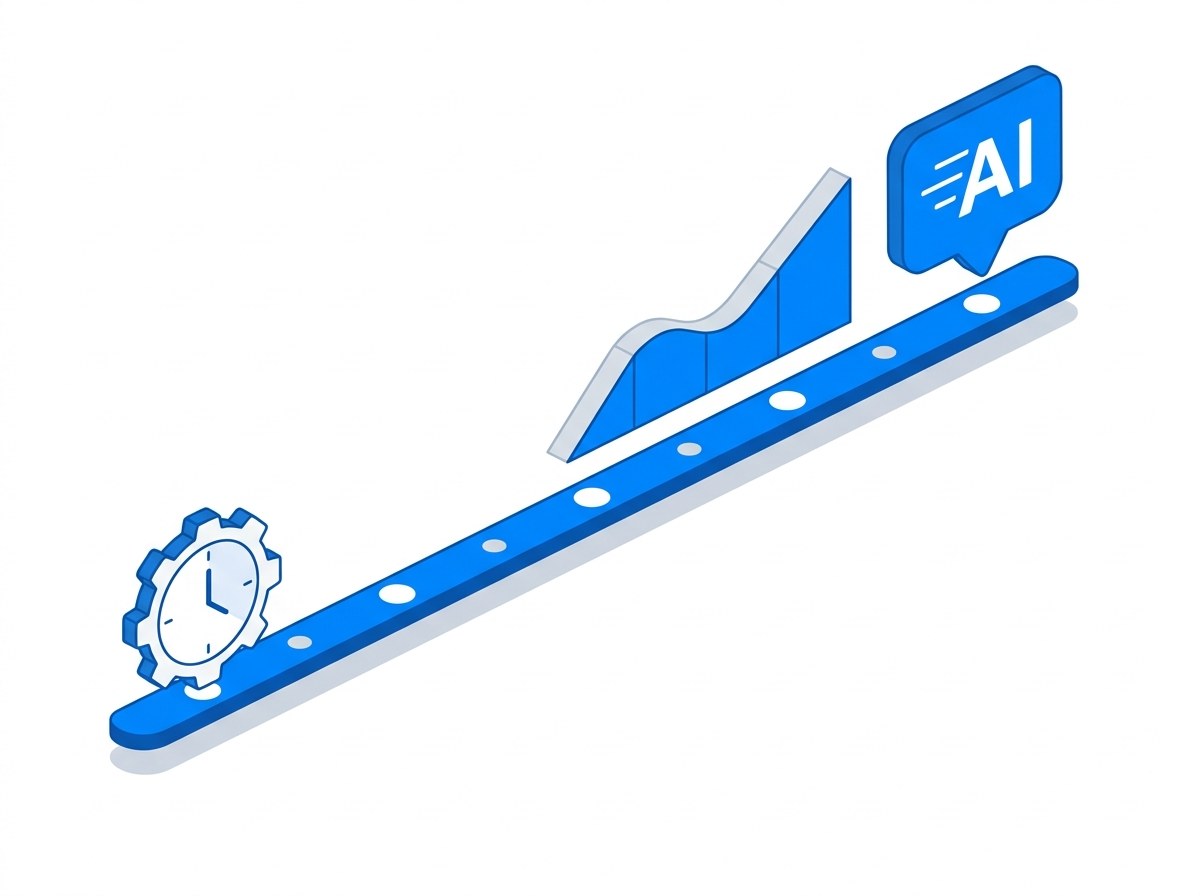
TL;DR Timelines
- Days 1-14: Foundation phase. Directory infrastructure, schema, Foursquare, Bing Places, Apple Maps live.
- Days 15-45: Initial citation phase. First mentions appear in ChatGPT, Perplexity, Claude, Google AIO.
- Days 45-90: Velocity phase. Citation rate ramps from 5-10% to 30-55%.
- Days 90-180: Compound phase. Weekly content + decision-stage pages drive lift.
- Days 180-365: Maturity. Sustained 50-75% citation rate ceiling.
The 5 Phases of an AI Search Engagement
AI search optimization is not a single push. It is five distinct phases stacked on top of each other, each with its own work and its own velocity curve. Knowing which phase you are in tells you whether the next 30 days should produce a step change or a slow grind.
Phase 1: Foundation (days 1-14)
The first two weeks are about getting the inputs in front of the AI engines. Foursquare claim and optimization happens here, which matters because Foursquare contributes roughly 70% of ChatGPT's local recommendation data. Bing Places and Apple Maps go live in this phase. LocalBusiness schema with the correct industry subtype gets implemented on the website (or queued for the client's dev team if their CMS is locked). NAP audit runs across the existing citation graph, and any inconsistencies get flagged for correction.
You should not expect any visible AI citations in this phase. The work is foundational. If an agency is showing you citation rate improvements in week 1, they are either cherry-picking queries or the data was already there before you signed.
Phase 2: Initial citations (days 15-45)
The first AI mentions start to appear here. This is when running a query like "best [your service] in [your city]" in ChatGPT or Perplexity returns your business in the top 3-5 recommendations for the first time. Claude lags this phase by 2-4 weeks because of slower index refresh cycles. Google AI Overviews start showing your domain as a citation source on long-tail queries ("[service] [city] cost", "[service] near me").
Citation rate at end of phase 2: 8-20% depending on vertical and city. This is the "is this working" phase, where the directory infrastructure pays off and you can verify with manual queries whether the AI engines have ingested your data.
Phase 3: Velocity (days 45-90)
This is when citation rate ramps fast. The first 1-2 decision-stage content pieces (comparison posts, pricing transparency, decision guides) go live and get indexed. Industry-specific citation network depth starts compounding. Review content gets restructured to surface specifics ChatGPT can cite ("same-day appointments", "flat-fee billing", "Spanish-speaking staff").
Citation rate at end of phase 3: 30-55%. First inbound inquiries that explicitly mention AI search start arriving in week 8-10. The lag between citation appearance and booked call is typically 15-30 days, which is why month 3 is the first month with reportable lead numbers attributable to AI search.
Phase 4: Compound (days 90-180)
Compounding is where weekly content cadence and decision-stage page coverage do most of the work. The retainer in this phase is producing more comparison content, expanding into surrounding cities and service-area pages, and continuously feeding the AI engines fresh structured data. Citation rate ramps from the 30-55% zone into the 50-75% zone here. AI-attributed inquiries roughly double from month 3 to month 6.
The work in phase 4 looks repetitive from the outside. It is. The point is consistency. A practice that ships 2 decision-stage pages per month for 6 straight months will out-cite a practice that shipped 12 pages in month 1 and then nothing.
Phase 5: Maturity (days 180-365)
Citation rate flattens around the 50-75% ceiling for most local businesses. Going higher requires either entering surrounding cities, doubling content production, or specializing into a niche-of-a-niche. This is the phase where most retainers shift from heavy content production to maintenance: monthly monitoring, quarterly content refreshes, and citation defense if competitors start optimizing in parallel.
The case for staying on a maintenance retainer past month 12 is straightforward. Citations decay if NAP data drifts, if competitors actively replace your data, or if content stops shipping for 6+ months. The maintenance cost is significantly lower than the build cost (roughly half), but it is not zero.
Timeline by Vertical (Day 1 to Day 90)
Vertical matters more than most people expect. The same retainer at the same monthly spend produces different timelines depending on competition density and search intent. Here is what we have measured across our audit base.
Benchmarks across single-location practices in mid-size US metros (population 250k-1.5M) at a $1,500/mo retainer.
Timeline by Retainer Tier
Spend buys parallel work, not faster individual tasks. An $800/mo retainer does the foundation work first, then content. A $2,500/mo retainer does both at the same time. The pricing breakdown for each tier is covered in the dedicated AI search optimization cost guide.
$800-$1,200/mo (single location, boutique)
Foundation phase runs days 1-21 (slightly slower because the same team handles audit + implementation sequentially). First citations day 35-50. First content piece day 30-45. Day-90 citation rate: 25-40%. AI-attributed inquiries by month 3: 5-12.
$1,500-$2,500/mo (multi-location or content-heavy)
Foundation phase compresses to days 1-14 because content production starts in parallel. First citations day 25-40. Two content pieces shipped by day 30. Day-90 citation rate: 35-55%. AI-attributed inquiries by month 3: 12-25. This tier is where the velocity phase actually feels like velocity.
$2,500-$3,000+/mo (specialty / multi-vertical)
Foundation, content, and citation network expansion all run in parallel from week 1. First citations day 20-35. Three to four content pieces shipped by day 30. Day-90 citation rate: 45-65%. AI-attributed inquiries by month 3: 20-40. The speed advantage compresses by month 6, where all tiers start converging on the 50-75% ceiling.
The honest truth: a $1,000/mo retainer running for 12 months out-cites a $3,000/mo retainer running for 4 months in almost every audit we have run. AI search compounds with consistency. Pick a tier you can sustain, not a tier you can stretch into for 90 days.
What Slows the Timeline Down
Five things account for almost all timeline slippage. Knowing them in advance is how you cut a slow 90-day rollout into a fast one.
- Slow GMB/GBP access. The single biggest avoidable delay. Adding the agency as a manager takes 60 seconds. We have had clients take 14 days. That is two weeks of foundation work blocked. The GBP optimization signals work cannot start until the access is shared.
- Slow client document handoff. NAP variations, service list, hours, photos, brand assets. If this takes 10+ days to arrive, the directory work runs late.
- Schema implementation friction. WordPress and Webflow ship LocalBusiness schema in under a day. Locked enterprise CMS or third-party dev shops can take 3-4 weeks.
- Aggressive competitor counter-optimization. If a vertical's top 3 players also hire an agency in parallel, citation ceilings compress. Still positive lift, just slower.
- Legacy NAP inconsistencies. A business with 30+ outdated listings under old DBA names or addresses needs corrections before new citations stick. Adds 2-3 weeks.
- Capacity exhaustion on the client side. Foundation phase requires 2-4 hours of client time (kickoff, doc handoff, content review). Owners with no marketing capacity often miss content review windows, which delays publishing.
Timeline Is One of Five Buying Questions
Timeline is the question this post is built to answer. The other four buying questions show up in every sales conversation we have, and we have dedicated pillars for each. Pricing breakdown lives in the cost pillar. Competitor comparison lives in the agency comparison post (Pleiades, Sterling Sky, Whitespark, Boring Local SEO, Localrank.so). The DIY vs hire decision matrix lives in the DIY vs agency pillar, and the day-by-day first 30 days breakdown has its own pillar too.
The reason all five matter together: timeline is meaningless without context on what you are spending and what you are getting. A 90-day citation rate of 40% means one thing at $800/mo and a different thing at $2,500/mo. Read all five questions before signing anything.
Want a timeline projection for your specific business?
A 15-minute growth analysis call. We test your AI visibility live, look at your vertical and city, and give you a realistic 30/60/90 day projection. No commitment.
Book a CallFrequently Asked Questions About AI Search Timelines
How long does AI search optimization take to start working?
Most local businesses see their first AI citations between day 30 and day 60. The fast end is single-location practices in lower-competition verticals (general dentistry, residential cleaning, mobile detailing) where the directory infrastructure work alone is enough to flip ChatGPT and Perplexity from zero to 8-15% citation rate inside the first month. The slow end is competitive verticals (personal injury law, restoration, cosmetic dental) in major metros, where the citation network has more existing depth to overcome and decision-stage content needs to compound for 60-90 days before it shows up. The 30-60 day window assumes the foundation work (Foursquare, Bing Places, Apple Maps, LocalBusiness schema) is completed in the first 14 days.
What is the typical timeline by vertical?
General dentistry: first citations day 25-40, 30-50% citation rate by day 90. HVAC and plumbing: first citations day 35-55, 25-40% by day 90 (Google Ads competition pulls AI optimization attention later in the funnel). CPA and accounting: first citations day 40-60, 30-45% by day 90. Restoration (water/fire/mold): first citations day 45-70, 25-40% by day 90. Personal injury and family law: first citations day 50-80, 20-35% by day 90. Med spas and cosmetic dental sit closer to the legal range because of higher competitor density. Pest control and landscaping move closer to general dentistry. Variance inside each vertical is driven more by city size than by the niche itself.
Why does the timeline vary so much between businesses?
Five inputs explain almost all the variance. First, GMB/GBP access speed. Practices that share access on day 1 vs day 14 see a two-week delta in foundation completion. Second, the existing citation footprint. A business with 30 existing inconsistent NAP citations needs corrections before new ones compound, which adds 2-3 weeks. Third, schema implementation friction with the website CMS. WordPress and Webflow ship LocalBusiness schema in under a day. Custom builds and locked-down enterprise CMS platforms can take 2-4 weeks waiting on the client's developer. Fourth, content production cadence (1 vs 2 pieces per month roughly doubles the velocity phase output). Fifth, vertical competition density.
How long until I see actual leads from AI search?
First inbound inquiries that mention they found you via ChatGPT, Perplexity, or Google AI Overviews typically arrive between day 45 and day 75. The lag between citation appearance and first booked call is 15-30 days because users see the recommendation, sit with it, and book later. By day 90, a single-location practice running a $1,500/mo retainer should see 8-20 AI-attributed inquiries per month. By day 180, that same practice should be in the 20-40 range. The closer you are to a high-intent vertical (restoration, urgent dental, plumbing), the shorter the citation-to-booking lag, often under 7 days.
What slows down AI search optimization timelines the most?
Four things, in order. (1) Slow GMB/GBP access. We cannot do the GBP optimization signal work until the client adds us as a manager. (2) Schema implementation blocked by the client's developer. If their CMS is locked or their dev shop quotes 4 weeks, we lose a month. (3) Aggressive competitor counter-optimization. If a vertical's top 3 players also hire AI search agencies in parallel, citation rate ceilings compress for everyone (still positive, just slower lift). (4) NAP inconsistencies across legacy citations. If a business has 30+ outdated listings under old addresses or old DBA names, those need correction before new citations stick.
Can I speed up the timeline by paying more?
Partly. A $2,500/mo retainer typically delivers first citations 7-14 days faster than an $800/mo retainer because the foundation work and the first content piece run in parallel from week 1 instead of sequentially. After day 60, the gap narrows. Both tiers converge around day 120 in terms of total citation rate ceiling. The compounding effect comes from total months on the engagement, not monthly spend. A $1,000/mo retainer for 12 months outperforms a $3,000/mo retainer for 4 months in almost every audit we have run. Velocity is bought with consistency, not budget.
When should I expect peak AI citation rate?
Peak typically lands between month 6 and month 12 in the 50-75% citation rate range across the major engines (ChatGPT, Perplexity, Claude, Google AI Overviews). After month 12, rate flattens. Going from 75% to 90% requires either entering low-competition surrounding cities, going aggressive on decision-stage content production (4+ pieces per month), or owning a niche the rest of the market is not optimizing for. Most local businesses should aim for the 50-65% ceiling and reinvest budget into other channels at that point.
How long do AI citations last once they appear?
Citations are sticky. Unlike Google rankings that recalculate constantly, AI engines update their training data and retrieval indices on slower cadences (Foursquare data refreshes hit ChatGPT roughly every 30-60 days, Perplexity is closer to weekly, Claude is the slowest at 2-3 month windows). Once a citation appears, it typically stays for 90-180 days minimum, even if you stop optimizing. The decay curve only steepens if a competitor actively replaces your data, your NAP changes without correction, or you stop publishing decision-stage content for 6+ months.
What is the realistic 90-day outcome benchmark?
For a single-location business at a $1,500/mo retainer in a moderate-competition vertical: 30-45% citation rate across ChatGPT, Perplexity, and Claude. 15-25% citation rate in Google AI Overviews. 2-3 published decision-stage content pieces (comparison, pricing, decision guide). Full directory infrastructure live (Foursquare, Bing Places, Apple Maps, 8-12 industry-specific directories). LocalBusiness schema with industry subtype on the website. 8-20 AI-attributed inquiries per month by month 3. If you are not hitting at least 60% of those benchmarks at day 90, the agency is underperforming or the implementation hit a structural blocker that should have been flagged.
Should I commit to a 12-month contract for AI search?
No. The work cycle is fast enough that you should see meaningful citation lift inside 90 days. Long contracts protect agencies from being held accountable to the timeline. Insist on month-to-month, especially in the first 90 days. If the agency cannot show citation rate improvement by day 60-90, you should be able to leave. Pleiades runs month-to-month for exactly this reason, and we publish the 30/60/90 day benchmark up front so the timeline conversation is concrete instead of vibes-based.
Get a real 90-day projection for your business
We test your AI visibility live on a free 15-minute call. Then we tell you exactly what to expect at day 30, day 60, and day 90 for your specific vertical and city.
Book the Free Audit →
About the author
Matthew Johnson is the founder of Pleiades Consultancy. He previously scaled his own marketing agency to multiple six figures before serving as CMO of an Amazon agency, where the client base tripled from 15 to 45 active clients during his tenure. He worked with some of the largest names in e-commerce, including Ridge Wallet, HexClad, BK Beauty, The Woobles, Walkize, Lonely Planet, and Obvi. He now works with local businesses to maximize their client acquisition and visibility through AI search with ChatGPT, Claude, Gemini, Perplexity, and Bing Copilot.